Repair or Replace Your Trane AC in Burbank (2026)
Last updated: 2026-06-13
The homeowner answer: This guide from Burbank Trane HVAC helps Burbank, CA homeowners decide whether to fix or replace a Trane AC, using the age, 50-percent, and age-times-cost rules with real 2026 SoCal bands in ZIP 91505. Call (213) 805-8137 or book online to get the number for your unit.
Quick facts
- Lean replace once a repair runs past ~50% of a new system AND the unit has cleared 10-12 years.
- Backstop check: unit age (years) times the repair quote over ~$5,000 points to replace.
- Trane condensers on the valley floor typically last 12-17 years.
- Capacitor/contactor $150-$450; compressor $1,200-$3,500; control board $400-$2,000.
- If you cross to the replace side: a new central AC lands $5,000-$12,000 and a heat pump $6,000-$16,000 in 2026 SoCal.
- In-warranty parts may be covered via the authorized dealer - check the serial.
- Federal 25C credit was repealed as of 12/31/2025; confirm any local rebate yourself.
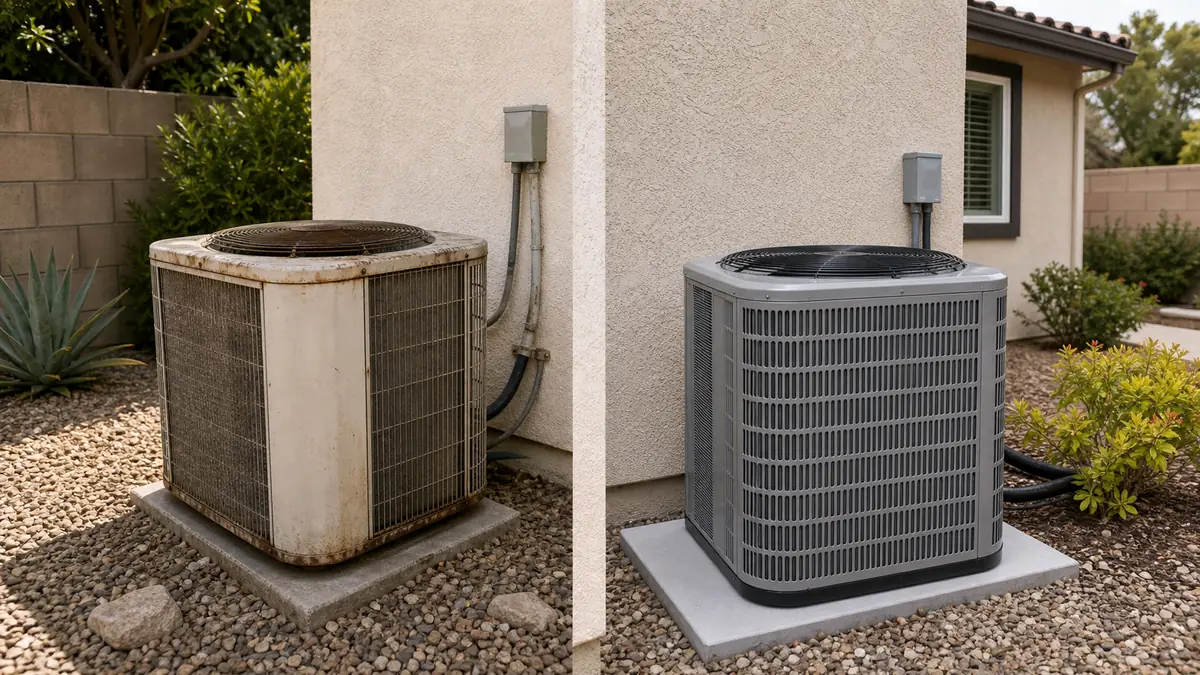
What are the actual repair-vs-replace rules?
Two plain checks clear out most of the guesswork. Start with the 50-percent rule: when one repair runs more than about half the price of a comparable new system and the unit has already passed 10-12 years, replacement usually carries the day. Then run the age-times-cost check: multiply the unit's age in years by the repair quote, and if the result tops roughly $5,000, tilt toward replacing. Picture a 15-year-old condenser facing a $400 repair - that scores 6,000, squarely replace territory; the same $400 on a 4-year-old unit scores 1,600, so you fix it.
These aren't rigid laws, they're filters. A cheap, common repair on an otherwise healthy unit is almost always worth doing. It's the expensive repair on an old, tired system - a compressor, a coil, a communicating board - that triggers the real decision.
| Unit age | Repair cost band | Lean |
|---|---|---|
| 0-8 years | Any common repair under ~$800 | Repair |
| 9-12 years | Under ~$1,000 | Repair, watch the trend |
| 9-12 years | $1,200+ (compressor, coil, board) | Get a replace quote too |
| 13+ years | $800+ | Replace usually wins |
| 13+ years | Compressor or coil failure | Replace |
How long should a Trane last on the Burbank valley floor?
Heat is the variable. A Trane condenser that might see 18-20 years on the mild coast typically runs 12-17 in Burbank, because 40-55 days a year above 90 F is hard duty on the compressor, capacitor, and coil. A unit that was oversized and short cycled its whole life lands at the low end; a right-sized, well-maintained system reaches the high end. Once a condenser passes 12 years, treat every major repair as a fork in the road and run the math before spending.
What do the common repairs actually cost?
Knowing the part bands keeps the decision honest. The cheap wear items - a dual-run capacitor or a contactor - sit at $150-$450 and are almost always worth fixing. The middle tier is a refrigerant leak repair and recharge at $225-$1,500, or a blower/ECM motor at $450-$2,300. The expensive failures are a compressor ($1,200-$3,500) and a communicating or inverter control board ($400-$2,000). When a single repair lands in that top tier on an old unit, that's when a replacement quote belongs on the table next to it.
| Job | Repair cost lane | Replace it instead at... |
|---|---|---|
| Capacitor / contactor | $150 - $450 | Rarely - just repair |
| Refrigerant leak + recharge | $225 - $1,500 | If the coil is the leak and unit is 13+ yr |
| Blower / ECM motor | $450 - $2,300 | If paired with other failures on an old unit |
| Compressor | $1,200 - $3,500 | Central AC replacement $5,000 - $12,000 |
| Control / inverter board | $400 - $2,000 | If the system is already past its life |
Does warranty status change the decision?
Hugely. Trane registered residential systems often carry a 10-year parts warranty, and a covered compressor or coil can swing a "replace" back to "repair" - but only if the work goes through the manufacturer's authorized dealer, who handles the covered part. We always read the serial to confirm registration and remaining coverage before quoting, because paying out of pocket for a part Trane would cover is the worst outcome. Out of warranty, the decision returns to the age and cost rules above. Compressor specifics live on the AC not cooling page.
If I replace, what should I buy - and what about rebates?
Replacing is the moment to fix sizing and efficiency in one move. Don't drop in another oversized single-stage unit; right-size with a Manual J and consider a two-stage XL18i or variable-speed XV20i matched to the load. The full sizing and SEER2 walkthrough is in the Trane buying guide. On the rebate question: the federal 25C credit was repealed on December 31, 2025, so a 2026 install draws no federal credit. LADWP and SCE heat-pump rebates in this area may help, but they cycle through funding rounds with amounts that move - check the current status before you let an incentive tip the call.
Three worked examples from Burbank homes
The rules are easier to trust with concrete numbers. These are illustrative diagnostic case scenarios, not customer records, but they mirror the calls we run on the valley floor.
Case 1: 6-year-old XR16 in Magnolia Park, dead capacitor
The condenser hums but won't start on a 94 F afternoon; the dual-run capacitor reads far below its rated microfarads. Repair cost about $300. Age-times-cost scores 1,800 - well under the $5,000 threshold - and the unit is young. Clear repair. We replace the capacitor, check the contactor while we're in the panel, and the system is back to cooling the same visit.
Case 2: 14-year-old XR13 in Chandler Park, failed compressor
The compressor is electrically failed and out of warranty; replacement runs $1,200-$3,500 installed on an aging unit. Age-times-cost scores well past 16,000, and a $2,000-plus repair clears half the cost of a new right-sized system. Replace. This is also the moment to fix the chronic oversizing - a properly matched two-stage XL18i for the small lot instead of another oversized single-stage condenser.
Case 3: 10-year-old XL18i in Burbank Hills, leaking coil
A refrigerant leak at the Spine Fin coil needs a coil replacement around $1,200-$1,800. The unit is on the bubble at 10 years. We check warranty status first - a registered coil may be covered through the authorized dealer, which flips it back to repair. Out of warranty, we weigh the coil cost against a full replacement and the homeowner's plans for the house. This is the genuine judgment call the rules are meant to frame, not decide alone.
How do I stretch the life I have left?
If the math says repair, a few habits buy more years on the valley floor. Change the filter on schedule so the coil doesn't ice and the blower isn't strained. Keep the outdoor condenser clear of fence overgrowth and debris so it can shed heat - critical on tight Burbank lots. Get a spring maintenance check before the 90 F days land, when a weak capacitor or low charge can be caught cheaply instead of failing under peak load. None of this saves a unit that's genuinely at end of life, but it reliably moves a borderline system toward the high end of its 12-17 year range rather than the low end.
What hidden costs change the replace math on a Burbank cottage?
The replacement bands above are equipment-and-install figures; on a pre-war Burbank home, three things routinely move the real number, and they belong in the decision. First, electrical. A heat pump or a larger condenser can draw more than an original 1930s 100-amp service was built for, so a panel upgrade adds an electrician and a meaningful line item. Second, ductwork. If a static-pressure test shows the old returns can't move the air the new system needs, you're sealing or resizing ductwork before the equipment can hit its rating - skip it and you've bought brand-new short cycling. Third, permits and verification. Burbank requires a permit on replacements, and Climate Zone 9 Title-24 typically pulls in HERS field verification of duct sealing plus refrigerant-charge and airflow checks. A homeowner weighing a $2,000 coil repair against "just replacing it" should price the whole replacement - equipment, possible panel work, duct correction, and verification - not the bare condenser, or the comparison is dishonest.
Does an oversized old unit change the decision?
It tilts it toward replace, and here's the logic. A lot of Burbank's cottages run condensers that were oversized on a square-foot rule decades ago, so they short-cycle, never wring out humidity, and wear their capacitors and compressors early. When that kind of unit faces a major repair, spending $1,500 to keep a system that was wrong for the house from day one is throwing good money after bad. Replacement is the one clean chance to fix sizing with a Manual J calc and drop in a right-sized two-stage XL18i or variable-speed XV20i that runs long and gentle. So when the repair is expensive AND the existing unit is oversized, the case to replace is stronger than the age-and-cost rules alone suggest - you're not just buying reliability, you're buying the comfort the house never had. A right-sized unit also tends to reach the high end of its 12-17 year valley-floor life instead of the low end.
What about a second opinion before you replace?
Get one whenever a contractor jumps straight to replacement on a unit under about 10 years, or quotes a 4-to-5-ton system for a small cottage. A failed capacitor, contactor, or even a single fan motor is a repair, not a reason to replace a young system, and an oversized replacement quote is usually a square-foot guess rather than a load calculation. A second opinion costs roughly a $139 diagnostic and can save thousands or, just as often, confirm that replacement really is the right call so you spend with confidence. We read the serial for warranty status, meter the actual failure, and give you the number both ways - repair and replace - so the decision is yours on real data, not pressure.
Common questions about repair vs replace in Burbank
What's the rule of thumb for repairing vs replacing a Trane AC?
Run two quick checks. Check one: if a single repair runs past roughly 50 percent of what a new system costs and the unit has already cleared 10-12 years, lean replace. Check two: take the unit's age in years times the repair quote, and when that number lands above about $5,000, replacement usually pencils out. A cheap fix on a young unit always stays a fix.
How long does a Trane condenser last in Burbank's heat?
On the valley floor, plan on 12-17 years for a Trane condenser, shorter than a coastal install because 40-55 days a year above 90 F is hard duty. Maintenance stretches it; oversizing and short cycling shorten it. Once you're past 12 years, every major repair deserves the replace math.
My compressor failed - is that automatically a replacement?
Not automatically, but close on an old unit. A compressor runs $1,200-$3,500 out of warranty; on a 14-year-old XR13 that's usually a replace. On a 5-year-old unit still under Trane's registered parts warranty, the part may be covered through the authorized dealer, which changes the math entirely - check the serial first.
Does replacing get me a rebate that tips the decision?
It can, but don't let it drive the call. The 25C federal credit was repealed on December 31, 2025, so nothing federal is left for 2026. LADWP or SCE heat-pump rebates around here might fit, yet they move through funding rounds and the amounts keep changing - confirm where the program stands today before a rebate gets a vote in the repair-versus-replace math.