Trane AC Short Cycling in Burbank, CA
The homeowner answer: Burbank Trane HVAC diagnoses Trane systems that short cycle across Burbank, CA, from the Rancho Equestrian District to Magnolia Park in ZIP 91505 - usually an oversized unit, low refrigerant, a dirty or frozen coil, or weak capacitor. Call (213) 805-8137 or book online to schedule a tech.
Quick facts
- Short cycling = repeated short runtimes that never finish a cooling cycle.
- Common causes: oversizing, low charge, dirty/frozen coil, weak capacitor, bad sensor.
- Oversizing is the classic cause in small pre-war Burbank homes.
- Each restart is peak compressor stress; cycling shortens equipment life.
- Diagnostic about $139; fixes range from a $150 capacitor to right-sizing.
- Service ZIPs: 91501, 91502, 91504, 91505, 91506, 91523. Hours: Weekdays 7am-6pm, weekends 8am-2pm.
- Independent; in-warranty compressors referred to the authorized dealer first.
Why does my Trane AC keep cycling on and off?
Short cycling means the system can't complete a normal cooling cycle. The causes split into three families: the unit is too big for the house and satisfies the thermostat too fast; a fault trips a safety control (low or high refrigerant pressure, a frozen coil, an overheating compressor); or a sensor and control problem (a thermostat in a bad spot or a failing capacitor causing hard starts). We measure runtime, pressures, and superheat to sort which one you have.
| Symptom | Likely cause / first check | Typical cost lane |
|---|---|---|
| Cools fast, shuts off, repeats - even rooms hot | Oversized unit for the load | Right-size / replace |
| Cycles with weak cooling | Low refrigerant tripping pressure controls | $225 - $1,500 |
| Cycles, ice on coil | Dirty filter/coil or starved return airflow | $120 - $1,500 |
| Hard starts then trips | Weak dual-run capacitor | $150 - $450 |
| Random cycling, comm alert | Control/board or sensor fault | $139 - $2,000 |
Why is oversizing so common in Burbank?
For decades, valley installers oversized condensers on a square-foot rule of thumb, ignoring the actual heat load. Burbank's small, often well-shaded 1920s-1940s cottages don't need a big tonnage unit, so an oversized system overshoots the thermostat in minutes and cycles all day. The cure isn't a thermostat tweak - it's a real load calculation and right-sized equipment, which a two-stage XL18i or variable-speed XV20i handles by running longer at lower output.
How does a tech pin down the cause?
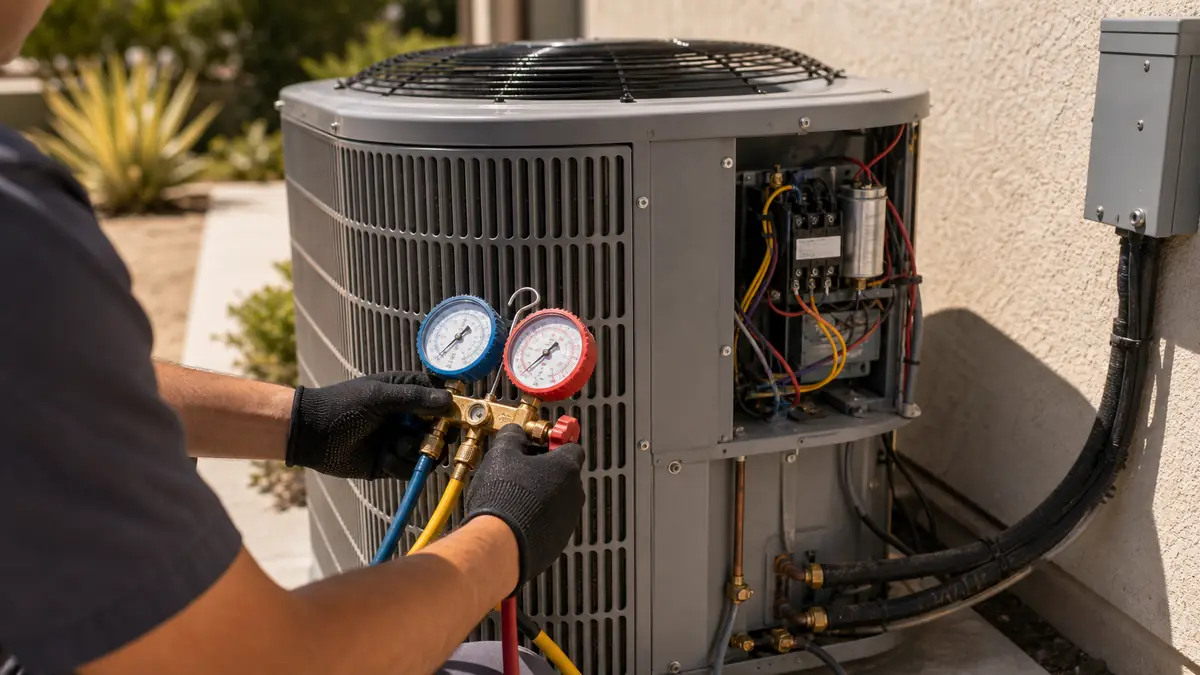
We time the cycle first: a true short cycle runs only one to three minutes before shutting off, versus a healthy 10-to-15-minute run that actually pulls the room down and wrings out humidity. Then we sort the three families with instruments. For an electrical hard-start, we read the dual-run capacitor - a weak one can't hold the compressor in and it kicks out on overload within seconds. For a refrigerant or airflow fault, we put gauges on the ports and read suction pressure, superheat, and subcooling, and check the coil for ice; low charge or a starved return drives the coil below freezing and trips the low-pressure or freeze control. For oversizing, the tell is a unit that cools the thermostat to setpoint in two or three minutes with rooms still uneven - the equipment is simply too large for the load, and no part swap fixes that. On communicating XV systems, a sensor or board fault shows as a plain-language alert on the XL850.
What can I check safely, and what needs a pro?
Safe homeowner checks: swap a gray, clogged filter; open any closed supply registers and clear blocked returns; and confirm the thermostat isn't mounted in direct sun or right under a supply vent, both of which fool it into short calls. That clears the easy airflow causes. Leave the rest to a tech - the capacitor holds a shock-capable charge, and gauges on the sealed refrigerant circuit, a real Manual J load calc, and any equipment resizing are pro-only work.
What does fixing short cycling cost in Burbank?
It depends on the family. A weak dual-run capacitor is the cheap end at $150-$450. A low charge from a leak runs $225-$1,500 once the leak is found and repaired, not just topped off. A dirty-coil or airflow cleanup ranges from a basic service up toward $1,500 if a coil cleaning and duct correction are involved. The roughly $139 diagnostic with a runtime and pressure check tells us which lane you're in. The expensive answer is oversizing: there's no part for it, so the durable fix is a right-sized two-stage XL18i or variable-speed XV20i that runs long and gentle - covered in the buying guide. Persistent icing often traces back to duct and return problems.
Common questions about Trane short cycling in Burbank
What does short cycling mean on my Trane AC?
Short cycling is when the system starts, runs only a minute or two, shuts off, and quickly restarts. It never completes a real cooling cycle, so rooms stay uneven and the compressor takes hard-start wear. On the Burbank valley floor it's a top warm-weather complaint and almost always fixable.
Can an oversized Trane unit cause short cycling in a small Burbank home?
Yes - it's the classic cause here. A condenser sized too big for a 1,100 square-foot bungalow blasts the thermostat to setpoint in minutes, shuts off, then restarts. Right-sizing the equipment to the actual load, instead of the old oversized rule of thumb, is the permanent fix.
Could a frozen coil be making my AC short cycle?
Indirectly. Low refrigerant or restricted airflow can freeze the coil, which then trips safety controls and cycles the system off and on. We check charge, superheat, and airflow; if the coil keeps icing, the root cause is a leak or a starved return, not the thermostat.
Is short cycling hard on a Trane compressor?
Very. Each start is the highest-stress moment for the compressor, and rapid restarts multiply that stress and the inrush current the capacitor must supply. Left alone, short cycling shortens compressor life and burns out capacitors early, so it's worth fixing promptly.