Trane Furnace Not Heating in Burbank, CA
The homeowner answer: Burbank Trane HVAC fixes Trane furnaces that won't heat across Burbank, CA, from Burbank Hills to Magnolia Park in ZIP 91504, reading the control-board LED flash codes for igniter, flame-sensor, pressure-switch, and high-limit faults. Call (213) 805-8137 or book online to schedule a tech.
Quick facts
- Diagnosed by LED flash code, not guesswork.
- Common no-heat parts: igniter, flame sensor, inducer, pressure switch, limit.
- 4 flashes = open high limit (low airflow); 8 = low flame sense; 9 = igniter.
- Most no-heat repairs run $150-$600 in 2026 SoCal.
- 6-flash rollout / cracked heat exchanger is a safety replacement, not a patch.
- Service ZIPs: 91501, 91502, 91504, 91505, 91506, 91523. Hours: Weekdays 7am-6pm, weekends 8am-2pm.
- Independent; in-warranty parts referred to the authorized dealer first.
Why won't my Trane furnace produce heat?
Heat on a Trane furnace is a chain of permissions, each one earned before the next is allowed. The inducer has to spin up first, the pressure switch then has to confirm real draft, only after that does the hot-surface igniter get power to glow, the gas valve is permitted to open against that proven flame surface, and finally the flame sensor has to register actual fire or the whole thing shuts back down. Break any single link and the control board kills the gas and parks a flash code. So a Burbank no-heat call is rarely "the furnace died" - it is one missing permission in that chain, or a safety that latched. And because the valley winter is so short, the parts most likely to fail are the ones that sat unused all year: igniters that crack on the first cold-night cycle and flame sensors gone hazy with oxide.
| Flash code / symptom | Likely cause / first check | Typical cost lane |
|---|---|---|
| 9 flashes - igniter circuit | Cracked hot-surface igniter | $180 - $400 |
| 8 flashes - low flame sense | Oxide-coated flame sensor | $150 - $300 |
| 3 flashes - pressure switch | Weak inducer, blocked flue/condensate path | $150 - $550 |
| 4 flashes - open high limit | Low airflow: filter, returns, blower | $120 - $450 |
| 6 flashes - rollout / polarity | Inspect heat exchanger; wiring/ground | $150 - replace |
What can I check before calling for no heat?
Confirm the thermostat is set to heat and above room temperature, the furnace switch and breaker are on, and the gas is on at the meter. Replace a dirty filter - a 4-flash high-limit trip is often just starved airflow. Read the flash code through the furnace sight glass and note the count. If you smell gas or a hot, burnt odor, leave it off and call; that's not a DIY situation.
How does a tech walk the ignition sequence?
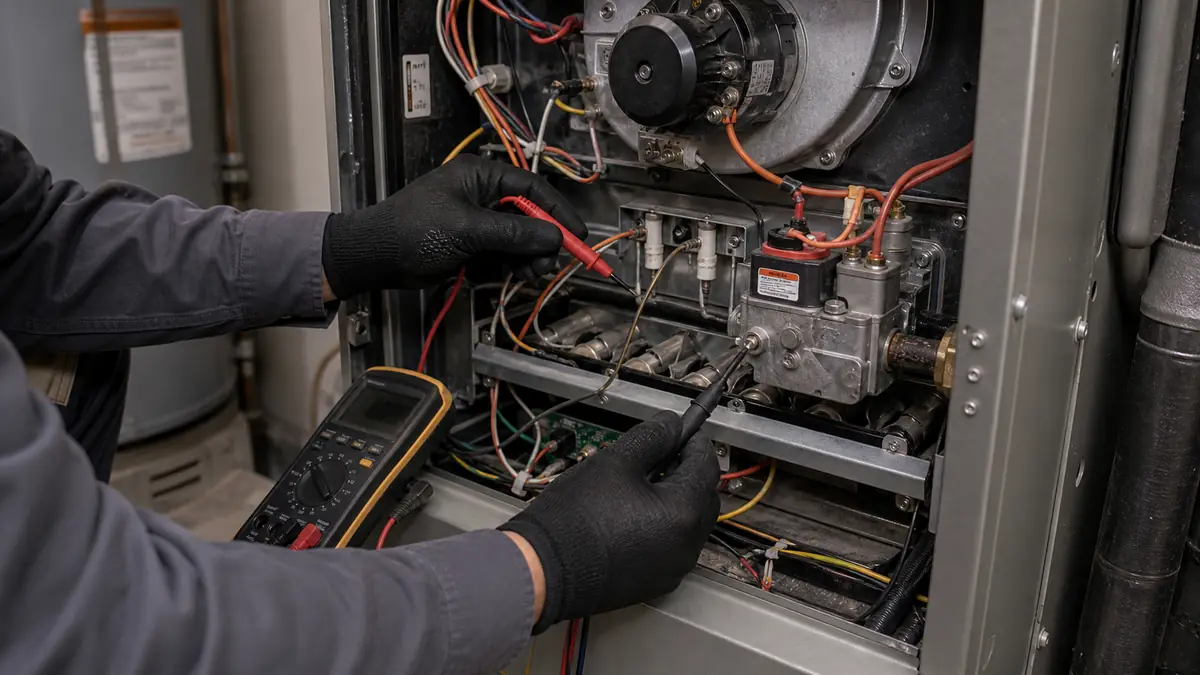
We diagnose by watching the furnace try to light and reading where the fixed sequence stalls. On a call for heat, the inducer should spin up first; if it doesn't, we check the inducer motor and its capacitor. Once it runs, the pressure switch must close - we meter it and inspect the flue and condensate trap for the blockage behind a 3-flash code. Next the hot-surface igniter should glow bright orange; a cracked or open igniter (9 flashes) reads infinite resistance on a meter and gets replaced. With flame established, the flame sensor must prove it by passing a few microamps of rectified current; an oxide-coated sensor (8 flashes) reads near zero and a careful clean or swap restores it. A 4-flash open high-limit sends us to airflow - filter, returns, and blower - not the burners. Throughout, we read the flash code at the sight glass first so we test the right link instead of guessing.
What is safe to check, and what needs a pro?
Homeowner-safe checks: thermostat set to heat and above room temperature, the furnace switch and breaker on, gas on at the meter, and a clean filter (a 4-flash limit trip is often just a clogged filter). Read and note the flash-code count through the sight glass. Stop there. Anything involving the gas valve, the igniter (line-voltage), the heat exchanger, or a burnt or gas smell is a pro-only job - and a 6-flash rollout or any gas odor means shut it off and call, because a cracked heat exchanger is a carbon-monoxide risk, not a part to bypass.
What does a no-heat repair cost in Burbank?
Most no-heat fixes are modest. A flame-sensor clean or replacement runs about $150-$300; a hot-surface igniter $180-$400; a pressure-switch or inducer issue $150-$550; and an airflow-driven high-limit trip $120-$450 once the filter, returns, or blower are sorted. The roughly $139 diagnostic locates the failed link by flash code and is often credited toward the repair. The exception is safety: a 6-flash rollout that traces to a cracked heat exchanger is not a repair lane at all - that furnace is replaced, and any new gas furnace in California must meet Ultra-Low NOx rules. Use the repair-or-replace guide for the age thresholds.
When does a no-heat call become a furnace replacement?
A cracked heat exchanger or repeated rollout is a hard stop - that furnace gets replaced, not repaired, for safety. Past about 18 years, when a no-heat call needs a blower module plus a gas valve, replacement usually wins, and any new gas furnace in California must meet Ultra-Low NOx rules. The furnace repair page goes deeper on parts, and the repair-or-replace guide covers the thresholds.
Common questions about Trane no-heat in Burbank
My Trane furnace won't light on the first cold Burbank night - why?
After a long warm valley year the furnace sits idle, so the first cold-snap call is usually a cracked hot-surface igniter, an oxide-coated flame sensor, or a stuck inducer. The control board flashes a code through the sight glass that points to which one. We read it instead of guessing.
What does 4 flashes on my Trane furnace mean?
Four flashes is an open high-limit: the furnace overheated because airflow dropped. The usual cause is a clogged filter, closed registers, or a failing blower, not the furnace itself. Restoring airflow clears it; if the limit keeps tripping we check the blower and return path.
Is my Trane furnace safe if it smells odd or trips on rollout?
Stop using it and call. A 6-flash rollout code or a burnt smell can indicate a cracked heat exchanger or flame rollout - a carbon-monoxide risk. That's a shutdown-and-inspect situation, not a part to bypass. We inspect the exchanger and tell you honestly whether it's a repair or a replacement.
Do Burbank homes even need furnace repair often?
Less than cooling, but it matters. Winters are short on the valley floor, so furnaces run little and then get asked to perform on a few cold mornings a year. Low usage means parts corrode and seize between seasons, which is why a quick pre-winter check catches most no-heat surprises.