Emergency AC Repair in Burbank, CA
The homeowner answer: Burbank Trane HVAC handles emergency no-cool Trane calls across Burbank, CA from the Media District to Magnolia Park in ZIPs 91501 to 91523 during a valley heat spike, triaging capacitor, contactor, and float-switch failures fast, so call (213) 805-8137 or book online on weekday and weekend hours, with the diagnostic about $139 and most swaps $150 to $450.
Quick facts
- Weekend coverage: Saturday and Sunday 8am-2pm, plus weekdays 7am-6pm.
- Phone triage first; many no-cool calls are a capacitor or tripped float switch.
- Diagnostic about $139; capacitor/contactor swaps $150-$450 in 2026 SoCal.
- Burbank runs 40-55 days a year above 90 F - peak failure season.
- Service ZIPs: 91501, 91502, 91504, 91505, 91506, 91523.
- Independent; in-warranty Trane parts referred to the authorized dealer first.
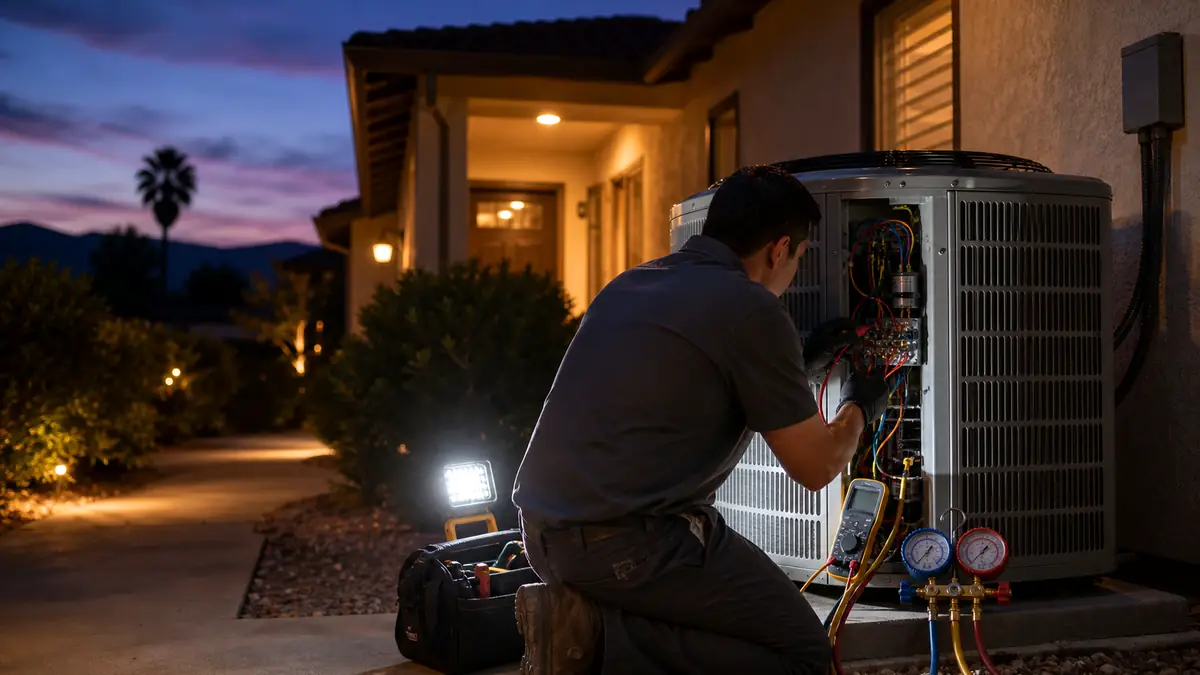
What counts as an AC emergency in Burbank?
On the valley floor, no cooling during a heat spike is a real emergency, especially for older residents and homes without shade. The most common true emergencies we run are a dead capacitor (the unit hums but won't start), a welded contactor (clicks, never engages), a tripped condensate float switch (cooling stops to prevent water damage), and a frozen coil from low charge or blocked airflow. Each has a fast first check.
| Symptom | Likely cause / first check | Typical cost lane |
|---|---|---|
| Outdoor unit hums, won't spin | Failed dual-run capacitor | $150 - $450 |
| Clicks but compressor never starts | Pitted/welded contactor | $150 - $450 |
| Indoor unit stops, no fault on the stat | Tripped condensate float switch / clogged drain | $139 - $400 |
| Coil iced, almost no airflow | Low refrigerant or restricted return - shut it off | $225 - $1,500 |
| Breaker keeps tripping on the condenser | Shorted compressor, fan motor, or wiring fault | $150 - $3,500 |
| Outdoor fan dead, compressor hot | Failed condenser fan motor or its capacitor | $150 - $900 |
| XL850 shows loss-of-communication | ComfortLink II comm wiring or board fault | $139 - $2,000 |
How do you triage a Burbank no-cool call?
We start on the phone to save you a wait in a hot house. We ask what the unit is doing - humming, clicking, dead, or iced - and whether the thermostat still calls for cool, because that narrows it before a truck rolls. On site, the fast diagnostic order on a Trane condenser is: confirm the call and 24V at the contactor, read line voltage, pull and meter the dual-run capacitor against its rating, inspect the contactor points, then check the float switch and condensate drain if the indoor unit cut out with no stat fault.
Most true Burbank emergencies resolve at that point because the high-frequency failures are wear parts - a drifted capacitor, a welded contactor, a tripped float - that we carry on the truck. If the read instead points to low refrigerant on an iced coil or a shorted compressor tripping the breaker, that is a deeper repair we scope honestly rather than throwing a capacitor at a compressor problem. On a communicating XV20i or XL18i we read the plain-language XL850 fault first.
Why do Burbank no-cool calls cluster on the worst days?
The valley floor sets the trap. Burbank sits in the southeastern San Fernando Valley heat pocket, runs 40 to 55 days a year at or above 90 F, and Hollywood Burbank Airport regularly logs valley-record highs. A capacitor that has been quietly drifting under its rating all spring will start a compressor at 78 F but not at a 95 F afternoon load, so the failures bunch on exactly the days every shop is booked. Add the crowded side-yard condenser placement common on tight Magnolia Park and Chandler Park lots - poor airflow around the coil pushes head pressure up - and a marginal part finally gives out under that combined stress.
That is why our phone triage matters: it sorts the same-visit wear-part fixes from the deeper refrigerant or compressor calls so we bring the right parts and you are not waiting twice in a hot house.
What should I do before the tech arrives?
- Set the thermostat to cool a few degrees below room temp and confirm it has power.
- Swap a clogged filter; a starved return ices coils and stops cooling.
- Check the breaker and the condensate float switch; reset a tripped breaker once only.
- If the coil is iced, switch to fan-only to thaw it and stop running the compressor.
What can you safely check yourself, and where do you stop?
A few things are safe and worth doing before a truck rolls. Confirm the thermostat is set to cool below room temperature and has power; replace a filter that is gray and packed, because a starved return ices the coil and stops cooling; look at the condensate drain and float switch under the indoor unit, since a full safety float deliberately halts cooling to prevent water damage; and reset a tripped breaker exactly once. Each of these is a no-tools, no-risk check that resolves a real share of Burbank no-cool calls.
Where you stop: anything past the panel. Do not open the condenser disconnect and probe the capacitor - a charged dual-run capacitor holds a dangerous shock even with power off. Do not keep resetting a breaker that trips again, do not add refrigerant from a hardware-store can to an iced system, and do not run a unit with a frozen coil. Those are the points where a wrong move turns a $150 capacitor into a damaged compressor or an injury, and where the meter and recovery gear we bring matter.
What does an emergency AC repair cost in Burbank?
The common emergencies are not the expensive ones, which is the good news in a heat spike. The diagnostic is about $139 in 2026 SoCal and is often credited toward the repair. A dual-run capacitor or a contactor - the two failures that strand most Burbank condensers in July - run $150 to $450 each, and a condenser fan motor is $150 to $900. A tripped float switch or a clogged condensate drain is a clear-and-test in the $139 to $400 lane.
The deeper repairs are rarer in a no-cool: a refrigerant leak repair and recharge on a Spine Fin system is $225 to $1,500, and a shorted compressor tripping the breaker is $1,200 to $3,500 out of warranty, lower if a covered part. A ComfortLink II communicating or inverter board on a variable-speed unit runs $400 to $2,000. We give the firm number after the on-site read; all bands are approximate 2026 SoCal ranges.
Is my emergency repair under warranty?
If your Trane system is registered and in its parts warranty, a covered failure like a compressor should route through the manufacturer's authorized dealer - but for the common emergency parts (capacitor, contactor, float switch), those are wear items we replace fast regardless. We read the serial, tell you the status, and get you cooling, then flag any covered part you should claim. The deeper diagnostics live on AC not cooling and short cycling.
Common questions about Burbank emergency AC repair
Do you offer weekend emergency AC service in Burbank?
Yes. Our weekend hours run 8am to 2pm Saturday and Sunday, which is when most summer no-cool calls land on the valley floor. We triage by phone first - if it is a simple capacitor or tripped float switch, we can often get you cooling again the same visit.
What can I check myself before calling for emergency AC repair?
Three things: confirm the thermostat is calling for cool and has power, replace a clogged filter, and check the breaker and the float switch on the condensate line. A full safety float will stop cooling to prevent water damage. If those are clear and the condenser still won't run, call us.
Why does my Burbank AC always die on the hottest day?
Because heat is the trigger. A capacitor that's been drifting weak finally can't start the compressor under a 95 F load, and contactors that have been arcing finally weld. The valley floor's 40-55 days a year above 90 F is exactly when marginal parts give out together.
Is a frozen coil an emergency I should run the system through?
No - shut it off. If the indoor coil is iced and air barely moves, running the unit risks slugging liquid refrigerant back to the compressor. Switch the system to fan-only to thaw it, then call. We find the airflow restriction or low charge that caused the freeze.
My breaker keeps tripping when the AC starts - can I keep resetting it?
Reset it once. If it trips again, stop - a repeatedly tripping condenser breaker usually means a shorted compressor, a failed fan motor, or a wiring fault drawing too much current, and repeated resets can worsen the damage or risk a fire. Leave it off and call. We meter the compressor windings and the fan circuit to find what is overloading it.
What is the fastest fix you can do on a Burbank no-cool call?
A dual-run capacitor swap. It is the single most common SoCal AC failure in heat - the unit hums but the compressor or fan will not start - and we carry the common sizes on the truck, so a capacitor or contactor is usually a same-visit fix that has you cooling again before we leave. Deeper faults like low charge or a compressor get scoped honestly.